Poverty is one of the most misunderstood concepts in everyday conversations. Ask ten people what it means to be poor, and you’ll get ten different answers. Some will say it’s about not having food. Others will argue it’s about not living the life you want. And a few will insist it’s all in the mind.
So which is correct?
The truth is: poverty is not just one thing. It exists in three distinct forms—objective (absolute), relative, and subjective. Understanding these differences is not just academic; it directly affects how you think, how you act, and ultimately, how you escape financial struggle.
Let’s break this down in the simplest way possible, then go deeper into what actually matters for your growth.
1. Absolute Poverty: The Survival Level
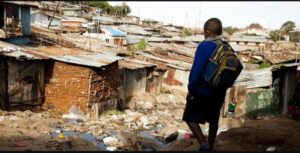
This is the most basic and universally agreed form of poverty.
Absolute poverty means:
- You struggle to get food regularly
- You lack stable shelter
- You don’t have access to basic clothing
- Your survival is uncertain
At this level, life is about staying alive, not improving your lifestyle.
This is the kind of poverty governments and global organizations try to measure and reduce. It’s objective because it can be clearly defined and observed. Either someone has access to basic needs, or they don’t.
Simple example:
If someone hasn’t eaten in days, has no roof over their head, and no stable source of income, they are absolutely poor.
There’s no debate here.
2. Relative Poverty: The Comparison Trap
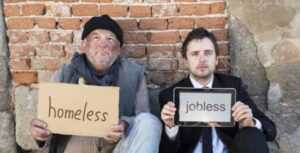
Now we move into a more complex layer.
Relative poverty is about comparison.
It’s not about whether you can survive—it’s about how your life compares to:
- The people around you
- Your social environment
- Your expectations
You might have food, a phone, and even some income—but still feel poor because:
- Others are earning more
- Others are living better
- You haven’t reached your desired lifestyle
Example:
Two people earn $400 monthly.
- Person A (a student) sees it as a lot of money
- Person B (with bigger responsibilities or ambitions) sees it as nothing
Same money. Completely different perception.
That’s relative poverty.
3. Subjective Poverty: The Psychological Game

This is where things get even more interesting.
Subjective poverty is about how someone feels about their financial state.
It’s internal.
Someone can:
- Have a stable income
- Live comfortably
- Own assets
…yet still say, “I’m broke” or “I’m poor.”
Why?
Because their expectations are higher than their current reality.
This form of poverty is driven by:
- Mindset
- Exposure
- Ambition
- Social media influence
Example:
A person earning $10,000 monthly may feel poor if their circle earns millions.
That feeling is real—but it doesn’t reflect their actual survival condition.
4. Where Most People Get It Wrong
The biggest mistake people make is mixing these three types of poverty together.
For example:
- Saying someone is not poor because they ate today → too simplistic
- Saying someone is poor just because they haven’t reached their dream life → too emotional
Both views are incomplete.
The correct way to think is:
- Absolute poverty = survival problem
- Relative poverty = lifestyle gap
- Subjective poverty = perception problem
If you don’t separate these, your thinking becomes weak—and weak thinking leads to poor decisions.
5. Why This Matters (Beyond Arguments)
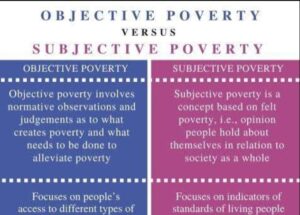
This isn’t just a debate topic. It directly affects your actions.
Let’s be blunt:
If you think you’re poor when you’re not in absolute poverty, you might:
- Complain instead of building
- Focus on emotions instead of strategy
- Stay stuck comparing yourself to others
On the other hand, if you ignore relative poverty completely, you might:
- Become comfortable too early
- Stop pushing for growth
- Miss opportunities to improve your life
So the goal is balance.
6. The Smarter Framework: Survival vs Progress
Instead of arguing about whether someone is “poor,” ask a better question:
Are you surviving, or are you progressing?
This question cuts through all confusion.
Survival Stage:
- You’re meeting basic needs
- You’re stable but not growing
- You’re focused on daily living
Progress Stage:
- You’re building skills
- You’re increasing income
- You’re investing in your future
Struggle Stage:
- You can’t meet basic needs
- You lack stability
- You’re in absolute poverty
This framework is more useful than labels.
Because labels don’t change your life—actions do.
7. The Hidden Danger of “Feeling Poor”
One of the biggest traps today is subjective poverty.
Social media has amplified this problem massively.
You see:
- People traveling
- People making money online
- People living luxurious lifestyles
And suddenly:
- Your normal life feels like failure
- Your progress feels slow
- Your current level feels like poverty
This is dangerous.
Because it creates:
- Impatience
- Poor financial decisions
- Unrealistic expectations
Many people jump into:
- Bad investments
- Scams
- Overtrading in forex
- Unsustainable lifestyles
…just to escape a feeling, not an actual survival problem.
8. Applying This to Real Life (Especially as a Student)
If you’re a student or just starting out, here’s your reality:
- You’re likely not in absolute poverty
- You may feel relatively behind
- You might experience subjective pressure
That’s normal.
But here’s the key:
You are not poor—you are early.
That’s a completely different mindset.
And it changes everything.
9. What Actually Matters: Building Phase Thinking
Right now, the most important category isn’t “rich” or “poor.”
It’s this:
Are you building or not?
A person earning little but learning skills, building income streams, and improving daily is in a better position than someone earning more but stagnant.
Building includes:
- Learning forex properly (not gambling)
- Developing data skills
- Creating content consistently
- Understanding money management
This is how you move from:
- Relative poverty → financial growth
- Subjective stress → confidence
10. Common Mistakes to Avoid
❌ Mistake 1: Defining poverty too narrowly
Saying “if you can eat, you’re not poor” ignores growth and future stability.
❌ Mistake 2: Living in comparison
Comparing yourself constantly will destroy your focus.
❌ Mistake 3: Using feelings as facts
Feeling poor doesn’t mean you are poor.
❌ Mistake 4: Arguing instead of acting
Debating definitions won’t increase your income.
11. A Practical Mental Model
Use this simple check anytime:
Step 1: Ask yourself
- Can I survive comfortably? → If yes, not absolute poverty
Step 2: Ask
- Am I where I want to be financially? → If no, relative gap
Step 3: Ask
- Am I taking daily action to improve? → This is what matters most
If Step 3 is “no,” that’s your real problem—not poverty.
12. Final Perspective
Poverty is not just about money—it’s about:
- Access
- Opportunity
- Mindset
- Direction
But the biggest mistake you can make is staying stuck in definitions.
Because at the end of the day:
- Absolute poverty requires urgent intervention
- Relative poverty requires strategy and growth
- Subjective poverty requires mindset control
And most people reading this are not in survival mode—they’re in building mode.
Conclusion
So, is poverty objective, relative, or subjective?
The correct answer is: all three—depending on the context.
But the real question is not what poverty is.
The real question is:
What are you doing to move forward?
Because whether you feel poor or not, whether others are ahead or not—your daily actions will determine your future.
Stop arguing labels.
Start building.
That’s the only definition that changes your life.