Most fully funded scholarships ask you to commit two, three, or four years of your life to a programme in another country. The Global Undergraduate Exchange Program (Global UGRAD) asks for one semester — roughly four to five months — and in exchange, it gives you a fully funded place at a US college or university, a Washington DC leadership workshop, 20 hours of community service, cultural immersion, and a permanent seat in a global alumni network of over 3,000 former participants from dozens of countries.
For undergraduate students who have never had the opportunity to study or live outside their home country, Global UGRAD is one of the most accessible and genuinely transformative programmes funded by the US government. It does not require you to be a graduate. It does not require professional experience. It does not require you to abandon your degree at home. You complete a semester in the USA and return to finish your degree — changed by the experience in ways that shape careers for decades.
This guide explains exactly what the programme is, what it covers, who qualifies, how applications work by region, and what gives candidates the best chance of being selected.
Check out More at Peakmindspaths
What Is Global UGRAD?
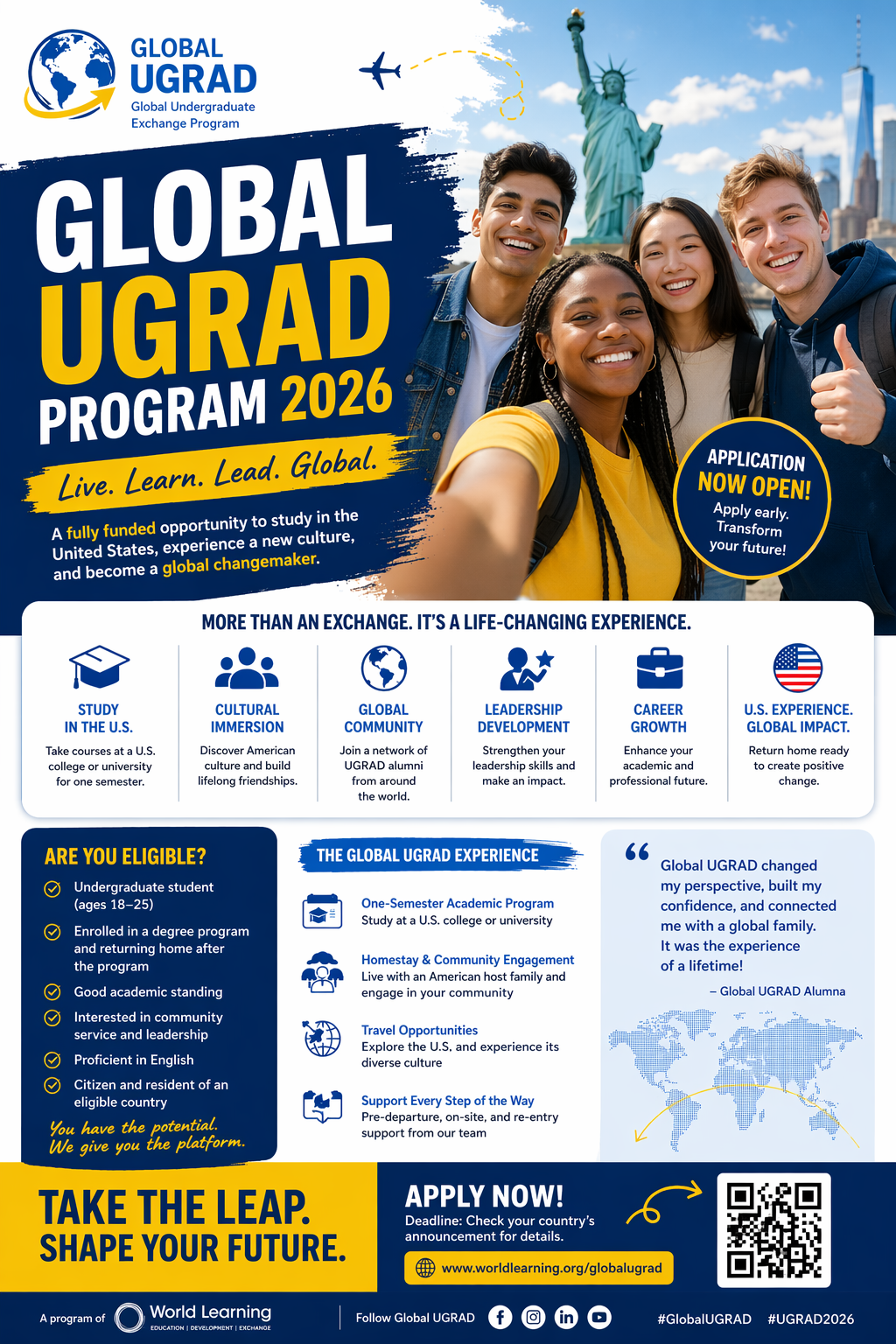
The Global Undergraduate Exchange Program (Global UGRAD) is a programme of the U.S. Department of State’s Bureau of Educational and Cultural Affairs (ECA). It provides non-degree, one-semester exchange scholarships to outstanding undergraduate students from participating countries around the world.
The programme is administered primarily by World Learning, a US-based international educational organisation, on behalf of the State Department. In Pakistan specifically, the programme is administered by IREX in partnership with the US Educational Foundation in Pakistan (USEFP).
Global UGRAD is not a degree programme. Students do not graduate from an American university — they return to their home institutions to complete their existing degree. What they gain instead is something different and, for many alumni, more lasting: an immersive semester of US academic life, professional development, cultural exchange, community service, and entry into a global network of emerging leaders.
Each year, the programme supports over 250 scholars from approximately 60 countries across Sub-Saharan Africa, East Asia and the Pacific, South and Central Asia, the Middle East and North Africa, Europe and Eurasia, and the Western Hemisphere. Participants live on campus alongside American students, enrol in regular undergraduate coursework, take a mandatory US Studies course, complete 20 hours of community service, and attend an end-of-programme leadership workshop in Washington, DC.
Quick Facts
| Detail | Information |
|---|---|
| Programme Name | Global Undergraduate Exchange Program (Global UGRAD) |
| Sponsor | U.S. Department of State, Bureau of Educational and Cultural Affairs |
| Administrator | World Learning (most countries) / IREX (Pakistan) |
| Host Country | United States of America |
| Study Level | Undergraduate (non-degree exchange) |
| Duration | One semester (approximately 4–5 months) |
| Programme Start | August (fall semester) or January (spring semester) |
| Funding Type | Fully Funded |
| Participants Per Year | Approximately 250+ |
| Eligible Countries | 60+ participating countries |
| Application | Through US Embassy or Fulbright Commission in home country |
| Contact | globalugrad@worldlearning.org |
What the Programme Covers
Global UGRAD is fully funded — removing every significant financial barrier to participation:
- ✅ Full tuition at a US host college or university
- ✅ Round-trip international airfare — economy class to and from the USA
- ✅ On-campus accommodation — students live in campus housing with American peers
- ✅ Monthly stipend — for incidental and personal expenses
- ✅ Health insurance — comprehensive coverage for the programme duration
- ✅ Required textbooks and course materials
- ✅ J-1 exchange visitor visa sponsorship — SEVIS fees and visa support handled by the programme
- ✅ End-of-programme workshop in Washington, DC — travel, accommodation, and activities covered
- ✅ Pre-departure and arrival orientations — preparation and support for the transition
Participants are not responsible for any programme costs. The US government funds the entire experience.
What Participants Actually Do During the Programme
This section matters — because Global UGRAD is not simply a semester of regular university classes. It is a structured exchange experience with specific components that every participant must complete.
Full-time undergraduate coursework. Participants enrol in regular courses from the host university’s existing curriculum — in their own field or in subjects they want to explore. The programme does not restrict participants to a specific curriculum, making it genuinely flexible across academic disciplines. Every participant must also take one mandatory US Studies course — an introduction to American society, culture, history, and institutions that deepens the cultural exchange experience.
20 hours of community service. All participants are required to complete 20 hours of community service during the semester. This is a programmatic requirement, not optional. It connects participants to the local American community beyond the campus, builds civic awareness, and develops practical leadership skills in an unfamiliar environment.
End-of-programme workshop in Washington, DC. Every Global UGRAD cohort attends a final leadership development workshop in Washington, DC — the centre of American political and public life. The workshop focuses on leadership skills, professional development, and re-entry preparation — helping participants think concretely about how to apply what they have learned when they return home.
Cultural immersion and professional development activities. Throughout the semester, participants engage in structured and informal cultural exchange with American peers, host families, and community members. Professional development sessions build skills in communication, leadership, networking, and career planning.
Eligibility Requirements
Because the programme is managed country-by-country through US Embassies and Fulbright Commissions, specific requirements vary. However, these core eligibility criteria apply across the vast majority of participating countries:
You Are Eligible If You:
- Hold citizenship in a participating country — US citizens and permanent US residents are not eligible
- Are at least 18 years old by August of the programme year (for fall semester entry)
- Are currently enrolled full-time at an accredited university or college in your home country, in good academic standing
- Have at least one full academic year remaining at your home institution after completing the UGRAD programme — the exchange cannot be your final semester of undergraduate study
- Have completed secondary education in your home country
- Demonstrate a solid command of written and spoken English — TOEFL or similar testing may be required at the shortlisting stage (the cost of required testing is covered by the programme for finalists)
- Are eligible to receive and maintain a J-1 student exchange visa for the USA
- Are cleared by a physician to participate (a health clearance requirement)
- Are committed to returning directly to your home country after the programme ends — no deferrals are permitted and alumni must return before pursuing any further US study or travel
Priority Preference:
The programme actively seeks participants from underrepresented backgrounds who have had little or no prior opportunity to study outside their home countries. Preference is given to candidates with little or no prior experience in the USA or elsewhere abroad. Students who have previously studied in the USA, or who have participated in other US government-funded exchange programmes, face a competitive disadvantage or may be ineligible.
Who Is NOT Eligible:
- US citizens and US permanent residents
- Students currently residing or working outside their home country
- Students who have previously participated in a US government-funded exchange programme (US Department of State, USAID, or similar)
- Students currently enrolled in academic or training programmes in the USA
- Employees of the organisations administering the programme (World Learning, IREX) and their immediate family members
- Local employees of US Embassies, Consulates, or USAID — and their immediate family members — for specified periods during and after employment
- Immediate family members of US Department of State or USAID employees — for one year after employment ends
Eligible Countries
Global UGRAD operates in participating countries across six regions. The exact country list changes periodically — always verify your country’s participation status through your local US Embassy.
Participating regions include:
Sub-Saharan Africa — including Kenya, Malawi, Mozambique, Niger, Zimbabwe, and others
East Asia and the Pacific — including Cambodia, China, Indonesia, Laos, Malaysia, Mongolia, Philippines, South Korea, Thailand, Vietnam, and Pacific Island nations
South and Central Asia — including Bangladesh, India, Nepal, Pakistan, Sri Lanka, and Central Asian republics
Middle East and North Africa — including Egypt, Jordan, Lebanon, Morocco, Tunisia, and others
Europe and Eurasia — including multiple Eastern European and former Soviet countries
Western Hemisphere — including selected Latin American and Caribbean countries
How to Apply — Country by Country
The application process is managed locally, through the US Embassy (Public Affairs Section) or Fulbright Commission in your home country. There is no central global application — you apply through the channel designated for your country.
General Application Steps:
Step 1 — Confirm your country’s participation and application period. Visit your local US Embassy website and search for “Global UGRAD”. Check whether applications are currently open, what the deadline is, and which organisation is managing the process in your country. Application periods typically open in October–November for the following academic year, with deadlines in December for most countries.
Step 2 — Prepare your application materials. Standard requirements across most country programmes include:
- Academic transcripts from your current university (most recent semester required)
- Personal statement essays (requirements vary by country — typically 2–3 short essays)
- Proof of current enrolment
- Passport or national ID copy
- Any extracurricular or leadership activity documentation
Reference letters are typically requested only from shortlisted candidates, not at the initial application stage — though this varies by country.
Step 3 — Submit your application online. Most country applications are submitted through either the World Learning programme portal at worldlearning-program.my.site.com/ugradstudent or through a local portal specified by your US Embassy. Applications must be completed in English. Deadlines are hard stops — once the portal closes, no submissions are accepted.
Step 4 — Shortlisting and TOEFL/language assessment. Shortlisted candidates are notified and may be required to take a TOEFL test or other English proficiency assessment. The programme covers the cost of required testing for finalists.
Step 5 — Interview. Many country programmes include an in-person or virtual interview for shortlisted candidates, conducted by the US Embassy or local partner.
Step 6 — Final selection and notification. Successful candidates are typically notified in May or June of the year preceding the programme. The programme then handles visa processing, university placement, housing, and pre-departure orientation.
What Makes Global UGRAD Competitive — And What Wins Applications
Global UGRAD explicitly seeks candidates from underrepresented backgrounds — those who have not had previous international opportunities. This is not merely a rhetorical preference. It is an active programme priority that shapes selection.
Candidates with no prior US experience have a genuine advantage. If you have never been to the USA, never studied abroad, and have spent your entire academic life in your home country, that background is a strength in this application — not a gap.
Leadership demonstrated in your community matters more than formal titles. Global UGRAD does not require a student council presidency or a formal leadership role. It looks for candidates who have taken initiative in any context — organising a community project, volunteering consistently, leading a study group, advocating for a cause, mentoring peers. What matters is that the leadership is real, specific, and demonstrable.
Your essays must answer the actual questions asked. Many countries include 2–3 personal statement prompts. The most common reasons for weak applications are answering a different question from the one asked, being too vague, or recycling the same general statements across all prompts. Read each question carefully and answer it specifically.
Academic standing must be solid — not necessarily exceptional. Global UGRAD looks for students in good academic standing, not top-ranked students exclusively. The programme seeks diversity of background, geography, and perspective — not a homogeneous pool of straight-A students. A solid academic record combined with strong community engagement and clear essay responses is more competitive than a perfect GPA alone.
The return commitment is taken seriously. Participants must return directly to their home country after the programme. The J-1 visa has a two-year home residency requirement in most cases. Applicants who indicate any ambiguity about returning — or whose essays suggest a desire to remain in the USA — are disadvantaged. The programme is explicitly designed to send people back with new skills and perspectives, not to facilitate migration.
After the Programme — What Alumni Do
Upon returning home, Global UGRAD alumni join a global network of over 3,000 former participants and are expected and encouraged to apply what they have learned to positive change in their communities.
Many alumni go on to pursue:
- Graduate study in the USA or internationally (often using UGRAD as a foundation for Fulbright and other scholarship applications)
- Careers in government, civil society, international organisations, and development
- Leadership roles in academia, media, business, and public service
- Advocacy and community development work in their home countries
Importantly, the Global UGRAD experience makes a measurable difference on future scholarship and fellowship applications. Many Fulbright, DAAD, and Chevening scholarship committees value demonstrated international exchange experience — and Global UGRAD alumni arrive at those competitions with a credible, well-regarded programme already on their CVs.
Important Things to Know Before You Apply
The programme cannot be your final undergraduate semester. You must have at least one full academic year remaining at your home institution after completing UGRAD. Apply while you still have time.
Deferrals are not permitted. If you are selected, you must begin the programme in the assigned semester — either August or January. There are no deferrals. If you cannot start on the assigned date, you must decline the award.
You cannot choose your US host university. Participants are placed at host institutions by the programme administrators — you do not select your own university. Placement decisions consider your academic background, field of study, and programme needs.
Prior US exchange programme participation may make you ineligible. If you have previously participated in any programme funded by the US Department of State, USAID, or similar US government bodies, confirm your eligibility with your local US Embassy before applying.
Applications must be in English. All essays and forms must be completed in English, regardless of which country you are applying from.
Final Thoughts
The Global Undergraduate Exchange Program is one of the most accessible fully funded opportunities available to undergraduate students anywhere in the world — because it does not ask you to abandon your degree, does not require professional experience, and specifically seeks students who have not had previous international opportunities.
A single semester in the United States, at an American campus, embedded in American academic and social life, with 20 hours of community service and a trip to Washington DC — it does not sound like much compared to multi-year scholarships. But for the thousands of alumni who have completed it,Global UGRAD consistently ranks among the most formative experiences of their lives.
Find your country’s application through your local US Embassy. Check your academic calendar. Apply before the December deadline.
For official programme information:
👉 exchanges.state.gov/global-ugrad
For programme inquiries:
📧 globalugrad@worldlearning.org
Related: The Fulbright Foreign Student Program 2026: How to Actually Win One of the World’s Most Competitive Scholarships
Dick and Mary Earle Scholarship in Technology 2026 (New Zealand): Up to NZD $25,000 for Postgraduate Research — Complete Guide