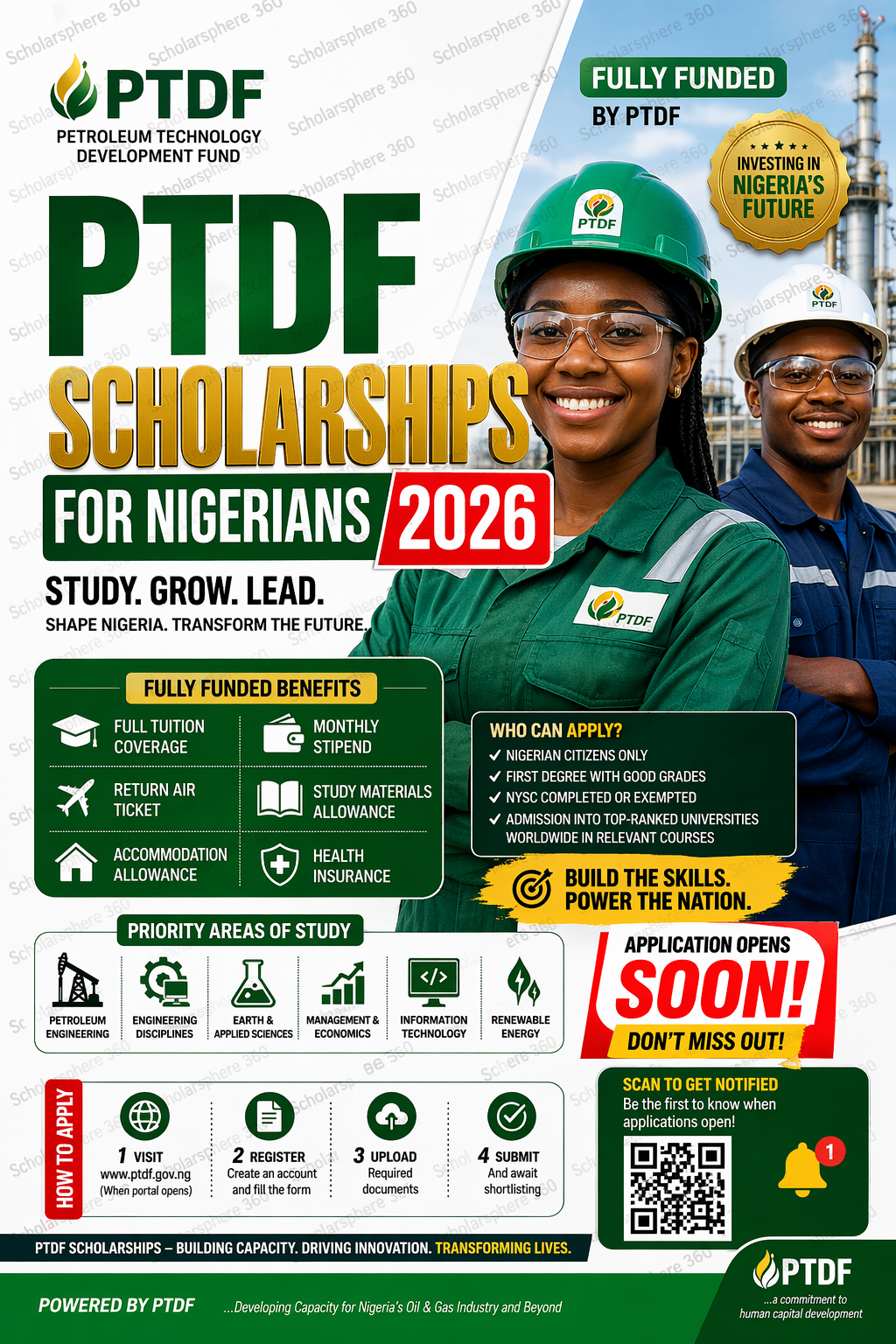
 Every year, the Petroleum Technology Development Fund (PTDF) quietly changes the lives of a small group of Nigerian graduates. It sends them — fully funded — to universities in the United Kingdom, Germany, France, and Malaysia, where they train at some of the world’s leading institutions in petroleum engineering, energy technology, and related disciplines. When they return, they carry something most Nigerian graduates never access: world-class technical expertise, international research experience, and a credential recognised across the global energy industry.
This is not a scholarship that announces itself loudly. But among Nigerian postgraduate students who know what it is, the PTDF Overseas Scholarship is considered one of the most valuable opportunities the federal government has ever created — not because it is easy to get, but because of what it actually delivers.
This guide gives you every verified detail about the PTDF Scholarship 2026: what it covers, who qualifies, the critical new rules introduced for 2026 that most applicants do not know about, how the selection process works, and exactly what you need to do to give yourself the best possible chance of being selected.
Check out More at Peakmindspaths
What Is the PTDF Scholarship?
The Petroleum Technology Development Fund is a Federal Government agency with a single, specific mandate: to develop indigenous human capacity and petroleum technology for Nigeria’s oil and gas sector. The Overseas Postgraduate Scholarship Scheme is the centrepiece of that mandate.
The programme identifies talented Nigerian graduates, funds their postgraduate education at PTDF partner universities abroad, and expects them to return with the technical knowledge and global perspective needed to drive innovation in Nigeria’s energy industry. Since its establishment, it has built a network of highly trained Nigerian engineers, scientists, and energy professionals who have gone on to work in government agencies, international oil companies, and academic institutions.
For 2026, the programme offers fully funded MSc and PhD scholarships at partner universities in the United Kingdom, Germany, France, and Malaysia.
Quick Facts
| Detail | Information |
|---|---|
| Sponsor | Petroleum Technology Development Fund (PTDF) |
| Type | Fully Funded Overseas Postgraduate Scholarship |
| Study Levels | MSc and PhD |
| Study Destinations | UK, Germany, France, Malaysia |
| Eligible Nationality | Nigerian citizens only |
| 2026 Application Deadline | 27 February 2026 |
| Application Portal | scholarship.ptdf.gov.ng |
| Local Scheme | Also available for study within Nigeria |
What the Scholarship Covers
The PTDF Overseas Scholarship is fully funded. Here is exactly what each selected scholar receives:
- ✅ Full tuition fees — and bench fees where applicable (laboratory or research facility charges)
- ✅ Return economy flight tickets — from Nigeria to the host country and back
- ✅ Accommodation allowance — to cover the cost of housing at or near the host university
- ✅ Monthly living expenses allowance — a stipend to cover food, transport, and daily costs
- ✅ Health insurance — comprehensive medical coverage for the duration of the scholarship
There is no gap in coverage designed to trip scholars up. PTDF funds the journey, the study, and the daily life of each scholar abroad. The only expectation in return is performance — and a return to Nigeria after graduation.
Study Destinations and Partner Universities
For 2026, PTDF scholarships are available at partner universities in four countries:
United Kingdom — including Robert Gordon University, University of Strathclyde, and University of Portsmouth (for PhD split-site programmes). MSc programmes are available across a broader range of approved UK partners.
Germany — through the PTDF/DAAD partnership, giving scholars access to one of Europe’s strongest engineering and research ecosystems. PhD applicants to Germany must secure a research supervisor before final selection interviews.
France — at approved French partner institutions in energy and petroleum-related disciplines.
Malaysia — at approved Malaysian universities offering PTDF-relevant programmes at competitive international standards.
Only programmes on PTDF’s approved list at these partner institutions are eligible. You cannot choose your own university or programme — your study must fall within what PTDF has pre-approved. The full list of sponsored courses and partner institutions is available on the official scholarship portal at scholarship.ptdf.gov.ng.
Critical 2026 Update: The Split-Site PhD Rule for the UK
This is the most important change for 2026 that most applicants are unaware of — and missing it can invalidate your entire application.
For 2026, UK PhD scholarships are limited to split-site programmes only.
This means that if you are applying for a PhD at a UK university, you will not spend your entire doctoral programme in the UK. Instead, you will split your residency between:
- The College of Petroleum and Energy Studies, Kaduna (CPESK) — PTDF’s premier domestic research institution
- A designated UK partner university (Robert Gordon University, University of Strathclyde, or University of Portsmouth)
The purpose of this arrangement is to strengthen local capacity and utilise CPESK’s world-class research facilities while combining them with the resources and reputation of the UK partner universities.
If you were planning to apply for a full-residency UK PhD in 2026, you need to know this before you proceed. The split-site structure is not optional — it is the only format available for UK PhD scholarships this year.
Eligible Fields of Study
PTDF scholarships are awarded exclusively for disciplines relevant to its mandate — building capacity in Nigeria’s oil, gas, and energy sector. Programmes deemed not relevant to this mandate will result in disqualification, regardless of how well-qualified the applicant is.
Eligible fields include:
- Petroleum Engineering
- Mechanical Engineering
- Electrical and Electronic Engineering
- Chemical Engineering
- Civil Engineering (with energy infrastructure focus)
- Geosciences and Geology
- Environmental Science (energy sector context)
- Renewable Energy and Energy Management
- Subsea Engineering
- Process Engineering
- Computer Science and Information Technology (applied to petroleum systems)
Your proposed course must also be consistent with your prior academic background. If your undergraduate degree is in accounting and you apply for a petroleum engineering MSc, your application will face scrutiny — and likely rejection — regardless of other qualifications.
Who Is Eligible?
MSc Applicants Must:
- Be a Nigerian citizen
- Have completed NYSC (National Youth Service Corps discharge certificate required)
- Hold a minimum of Second Class Upper (2:1) in their first degree — or Second Class Lower (2:2) with documented, relevant industry experience
- Possess at least five O’Level credits including English Language and Mathematics
- Be computer literate
- Have a verified National Identity Number (NIN) — NIMC verification is required before applying, and verification charges apply
PhD Applicants Must:
- Meet all the MSc eligibility requirements above
- Hold a master’s degree relevant to the proposed research area
- Submit a research proposal of not more than five pages, covering: topic, introduction, objectives, methodology, and mode of data collection
- For Germany specifically: secure a research supervisor at the German partner institution before final selection interviews
- Lecturers applying must submit a letter from their Vice Chancellor confirming they are not receiving any other scholarship
Who Is NOT Eligible:
- Anyone who has previously received a PTDF scholarship at the same level (MSc cannot re-apply for MSc; PhD cannot re-apply for PhD)
- Anyone who has previously been offered a PTDF scholarship but declined it
- Anyone currently employed by or receiving funding from any organisation in a manner that conflicts with PTDF’s terms
- Anyone applying for a programme outside PTDF’s approved list
- Anyone submitting multiple applications — this results in automatic disqualification
Required Documents
Gather these before the application window opens. Missing or illegible documents result in automatic disqualification — no exceptions.
For all applicants:
- First degree certificate or statement of result
- Complete academic transcripts from all tertiary institutions attended
- NYSC discharge certificate
- WAEC/GCE/SSCE/NECO results — include your PIN numbers so PTDF can verify results directly on the relevant portal
- Recent passport photograph
- Local Government Identification Letter
- Proof of NIN verification
For PhD applicants (additional):
- Master’s degree certificate
- Research proposal (maximum five pages)
- Evidence of membership in relevant professional associations
For lecturers:
- Letter from Vice Chancellor confirming no other scholarship is being received
Important: Shortlisted candidates invited for interview will be required to present their transcripts in person. Request your official transcripts from your institution as soon as possible — do not wait until you are shortlisted. Transcript requests at Nigerian universities can take weeks.
How to Apply: Step-by-Step
Step 1 — Visit the Official PTDF Scholarship Portal
Go to scholarship.ptdf.gov.ng — this is the only official application platform. Any other website or portal claiming to process PTDF applications is not authorised. Do not submit personal documents or pay any fees to unofficial channels.
Step 2 — Create Your Account
Register with a valid, active email address. An email with login instructions and a password setup link will be sent to you. Verify your account immediately and keep your login credentials safe.
Step 3 — Read the Guidelines Thoroughly
Before filling in a single field, read all official guidelines published on the portal. Familiarise yourself with the full list of approved courses and partner universities. Your programme selection must come from this approved list — choosing a programme not on the list wastes your entire application.
Step 4 — Complete the Application Form
Fill in all personal, academic, and professional details accurately. Select your preferred programme and partner institution from the approved list. Double-check every entry before moving to the next section.
Step 5 — Upload Your Documents
Scan and upload clear, legible copies of all required documents. Illegible scans and falsified documents result in automatic disqualification. Ensure every file is complete and readable before uploading.
Step 6 — Submit Before the Deadline
The 2026 overseas scholarship deadline is 27 February 2026. The portal closes at the deadline — there are no extensions and no late submissions. Submit your completed application well before the deadline to avoid technical issues.
How PTDF Selects Scholars
The selection process is multi-stage and rigorous. Understanding it helps you prepare properly at each phase.
Stage 1 — Academic Screening
All submitted applications are screened against the eligibility criteria. Applicants who do not meet the minimum requirements are eliminated at this stage. This is automated and objective — meet the criteria or do not proceed.
Stage 2 — Merit Ranking by State
Shortlisted applicants are ranked by academic merit within their state of origin. PTDF applies a national spread principle — ensuring that selected scholars come from across Nigeria’s states and geopolitical zones, not concentrated in a few locations. This means your competition for selection is primarily other applicants from your state, not the entire national pool.
This is a critically important detail that most applicants overlook. Understanding the state-by-state selection dynamic can inform where and how you position your application.
Stage 3 — Interview
Top-ranked applicants from each state are invited for interview. The selection committee assesses candidates against the following criteria (all verified from official PTDF guidelines):
- Academic merit — quality of degrees, academic transcripts, and relevant professional qualifications
- Quality and relevance of the proposed study plan — how well your chosen programme connects to your background and to PTDF’s mandate
- Professional qualifications and experience — particularly for 2:2 applicants seeking entry on the basis of relevant industry experience
- Research proposal quality — for PhD applicants, this is assessed independently and scored on clarity, relevance, and feasibility
Shortlisted candidates must bring physical copies of all transcripts to the interview. Request them now.
Stage 4 — Final Selection and Approval
The PTDF Steering Committee reviews the selection committee’s recommendations and approves final offers. Successful candidates are notified officially through the portal and via the contact details provided in their application.
Application Timeline
| Stage | Date |
|---|---|
| 2026 application opens | January 2026 |
| 2026 application deadline | 27 February 2026 |
| Academic screening | March–April 2026 |
| Interviews | April–May 2026 |
| Final selection and notification | May–June 2026 |
| Programme commencement | September/October 2026 |
What Gives a PTDF Application the Best Chance
Choose Your Programme With Precision
Your programme must be on the approved list, relevant to PTDF’s mandate, and consistent with your undergraduate background. Any misalignment at this intersection is disqualifying. Before filling in the application, identify two or three programmes from the approved list that genuinely fit your academic background and career goals — then choose the strongest match.
Prepare Your Documents Before the Portal Opens
The biggest administrative reason for failed applications is documents that are not ready when needed. Your transcripts, NYSC certificate, O’Level results with PINs, and NIN verification must all be in order before you log into the portal. Start this process months in advance — especially transcript requests, which can take considerable time at Nigerian universities.
For PhD Applicants: Treat the Research Proposal as the Centre of Your Application
The five-page research proposal is your single most powerful tool for differentiation at the PhD level. It must cover the topic clearly, explain the problem and why it matters to Nigeria’s energy sector, state your objectives specifically, describe your methodology, and outline your mode of data collection. Vague proposals with generic language will not survive the interview stage. Work with a supervisor or academic mentor to sharpen yours before submission.
For Germany PhD Applicants: Secure Your Supervisor First
This is a non-negotiable requirement for the PTDF/DAAD Germany PhD track — you must have a confirmed research supervisor at the German partner institution before final selection interviews. Do not assume you can address this after applying. Contact potential German supervisors as early as possible, share your research proposal, and secure an in-principle agreement before the interview stage.
Understand the State Selection Dynamic
Because PTDF applies a national spread principle, your primary competitors are other applicants from your state — not the entire national pool. Knowing this, focus your preparation on being clearly among the strongest applicants from your state. Do not be intimidated by the overall volume of national applicants — the actual competition you face is geographically bounded.
Common Mistakes That Lead to Rejection
Applying for a programme not on the approved list. This is the most fundamental error. Always verify your programme’s approved status on the official portal before submitting.
Submitting multiple applications. Automatic disqualification. One application only.
Applying for a programme not on the approved list. This is the most fundamental error. Always verify your programme’s approved status on the official portal before submitting.
Submitting multiple applications. Automatic disqualification. One application only.
Illegible or falsified documents. Automatic disqualification. Scan clearly and submit honestly.
Not having NIN verified before applying. NIN verification through NIMC is a prerequisite. Verification charges apply. Complete this well in advance.
Not requesting transcripts early. If you are shortlisted and cannot present transcripts at interview, your candidacy is compromised. Request them immediately.
A weak or generic PhD research proposal. The committee reads many proposals. Generic language, vague objectives, and unclear methodology produce low scores. Be specific and honest about what you are proposing to do.
Applying for the same or a lower scholarship category as a previous PTDF beneficiary. This makes you ineligible regardless of all other qualifications.
Missing the 27 February 2026 deadline. The portal closes. No extensions are granted.
About the Petroleum Technology Development Fund
PTDF was established by the Federal Government of Nigeria under the PTDF Act to develop the human and material resources needed to grow and sustain Nigeria’s petroleum and energy industry. Since inception, the Fund has sponsored thousands of Nigerian professionals and academics through its overseas and local scholarship schemes, creating a cadre of technically trained Nigerians who occupy positions in oil companies, government agencies, universities, and international organisations.
The Fund also maintains the College of Petroleum and Energy Studies, Kaduna (CPESK) — a world-class domestic research institution that, from 2026, plays a formal role in the split-site PhD structure for UK scholarships.
PTDF scholarships are not given to fill seats. They are given to build a profession — the profession of petroleum and energy technology in Nigeria. Every scholar selected carries that responsibility.
Final Thoughts
The PTDF Scholarship 2026 is one of the few scholarship programmes in Nigeria where the government’s investment is directly proportional to the quality of what scholars receive. Fully funded. Internationally located. Industry-relevant. And designed to return trained Nigerians to the sector that needs them most.
The 2026 cycle has already opened and the deadline — 27 February 2026 — is close. If you are reading this before that date, the window has not yet closed. Act now.
If you are reading this after the 2026 deadline, save this guide and begin preparing for 2027. The most successful PTDF applicants are not those who rush at the last moment — they are those who spend months building the right academic profile, gathering the right documents, and crafting the right research proposal long before the portal opens.
Visit the official portal, read the guidelines, prepare your documents, and submit a strong application.
👉 Official portal: scholarship.ptdf.gov.ng
*Related: Chevron Nigeria Internship Program 2026: How to Apply, Eligibility, and What Most Applicants Miss
Mastercard Foundation AfOx Scholarship 2026 at University of Oxford: Fully Funded for African Students — Complete Guide