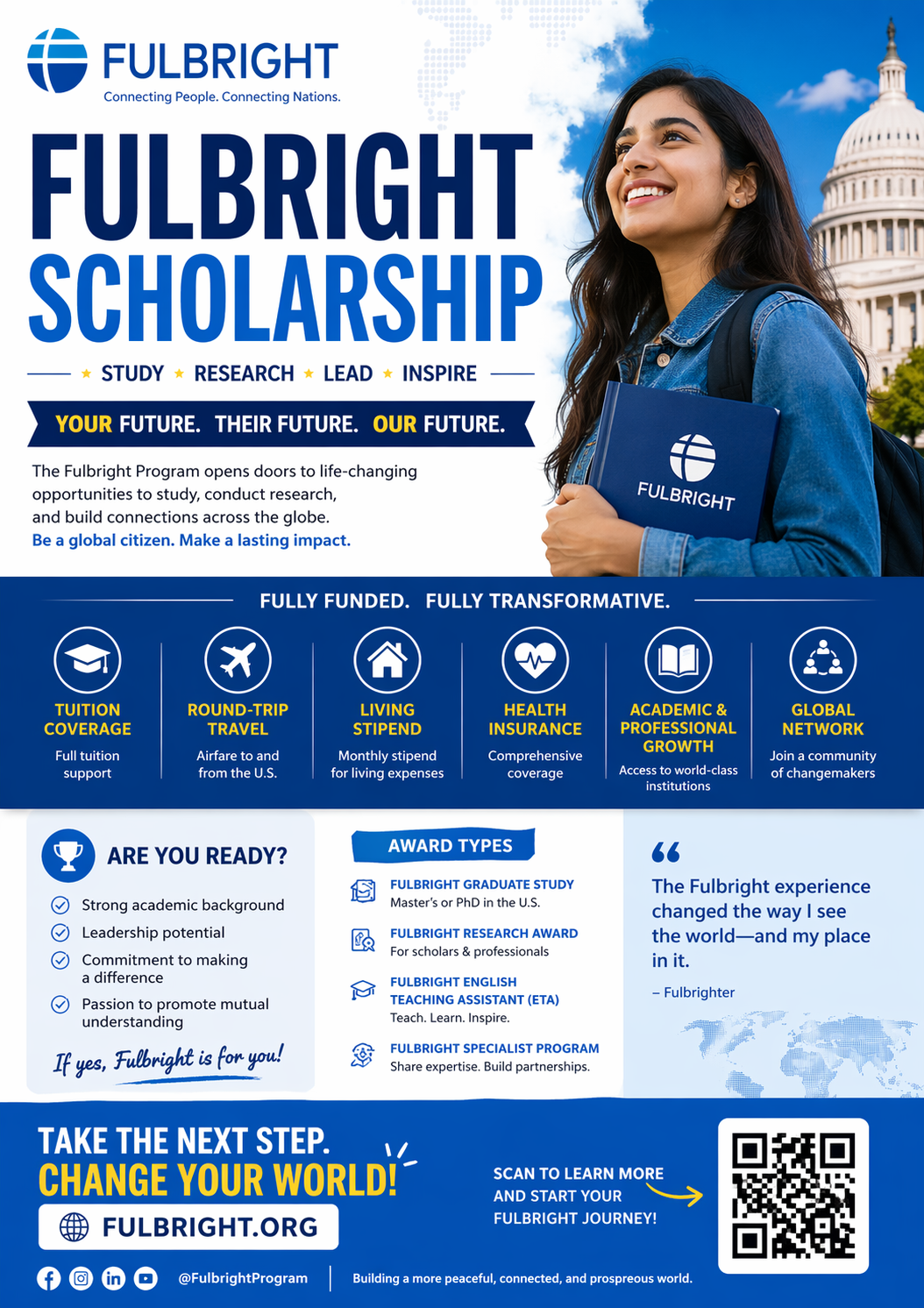
 Every year, approximately 4,000 international students receive a Fulbright scholarship to study in the United States. That sounds like a lot — until you consider that hundreds of thousands apply from over 160 countries, competing through national commissions, U.S. Embassy review panels, and the Fulbright Foreign Scholarship Board before a single award is made.
The Fulbright Foreign Student Program is not just a scholarship. It is one of the most extensive, well-resourced, and institutionally complex international exchange programmes in the world — operated by the U.S. Department of State, administered country-by-country through binational Fulbright Commissions and U.S. Embassies, and designed to build not just academic credentials but long-term mutual understanding between the United States and the rest of the world.
This guide does not give you a generic list of tips. It tells you what the Fulbright programme actually is, how it actually works, what it actually funds, and what the selection process actually evaluates — because understanding those things is the difference between an application that succeeds and one that does not.
Check out More at Peakmindspaths
What the Fulbright Foreign Student Program Actually Is
The Fulbright programme was established in 1946 by US Senator J. William Fulbright following World War II. His premise was simple and radical: lasting peace between nations depends on mutual understanding between peoples, and education creates that understanding better than almost anything else.
Since 1946, the programme has funded over 400,000 scholars, students, teachers, artists, and researchers from and to more than 160 countries. Its alumni include Nobel Prize winners, Pulitzer Prize winners, heads of state, ambassadors, Supreme Court justices, and leading figures in science, arts, business, and public life across the world.
The Fulbright Foreign Student Program is the strand of the programme specifically designed for non-US citizens who want to study or conduct research in the United States. It enables graduate students, young professionals, and artists from abroad to:
- Study for a master’s or doctoral degree at a US university
- Conduct research at a US academic institution
- Undertake non-degree academic study or professional development
The programme is not the same in every country. Eligibility requirements, available award types, application deadlines, and selection processes are all determined by the Fulbright Commission or US Embassy in your home country. This is the most important thing to understand before you apply — and it is what most generic guides fail to communicate clearly.
Quick Facts
| Detail | Information |
|---|---|
| Programme Name | Fulbright Foreign Student Program |
| Sponsor | U.S. Department of State (Bureau of Educational and Cultural Affairs) |
| Administrator | Fulbright Commissions / U.S. Embassies worldwide |
| Implementing Organisation | Institute of International Education (IIE) / AMIDEAST |
| Study Destination | United States of America |
| Study Levels | Master’s, PhD, Research, non-degree study |
| Eligible Countries | 160+ countries |
| Awards Annually | Approximately 4,000 |
| Duration | Varies by country and programme (typically 1–4 years) |
| Application | Through your home country’s Fulbright office |
| Official Website | foreign.fulbrightonline.org |
What the Fulbright Scholarship Covers
The financial package varies by country, but most Fulbright Foreign Student awards include:
- ✅ Full tuition fees — covered directly at the host US university
- ✅ Monthly living stipend — to cover housing, food, and daily expenses
- ✅ Round-trip international airfare — economy class to and from the USA
- ✅ Health and accident insurance — J-1 visa health benefit plan
- ✅ J-1 student exchange visa sponsorship — SEVIS fees and visa support
- ✅ Settling-in and book allowances — in many country programmes
- ✅ Academic enrichment activities — professional development, networking events, and cultural programmes throughout the award year
The scholarship funds the full duration of the approved programme — from day one of study through to completion, within the agreed award period.
One critical exclusion to know: Fields with clinical requirements — specifically dentistry, medicine, pharmacy, and nursing — are not eligible for the Fulbright Foreign Student Program. However, related public health fields such as public health policy, health administration, and nursing administration are permitted. If your field sits near this boundary, contact your country’s Fulbright office before applying.
The Two Placement Models — and Why They Matter
This is a detail that most articles skip entirely, but it significantly affects your application strategy.
Once nominated for a Fulbright award, there are two ways your university placement in the USA is handled:
IIE-Placement: The Institute of International Education (IIE) handles your university placement on your behalf. Their Placement Team uses your application profile to apply to suitable US institutions, manages admission decisions, negotiates funding, and communicates directly with universities. You follow their guidance and do not need to manage the university application process independently. This model is common in countries where Fulbright Commissions administer the programme.
Self-Placement: You apply directly to US universities of your choice, manage all application deadlines and requirements, submit test scores and application fees yourself, and present your admission offer as part of your Fulbright application. This model is used in some country programmes and suits candidates who already have specific institutions or supervisors in mind.
Check with your country’s Fulbright office to understand which placement model applies to you. This determines whether you need to identify and apply to US universities independently — a significant logistical difference that you need to know about early.
Types of Fulbright Foreign Awards
Fulbright Foreign Student Program
The main track — for graduate students pursuing master’s or doctoral degrees, non-degree research, or specialised academic study at US universities and research institutions.
Fulbright Visiting Scholar Program
For academic faculty, researchers, and professionals who want to conduct advanced research or teaching at a US institution. This is separate from the student programme and requires different qualifications. Non-US citizen professors and researchers apply through their home country’s Fulbright office.
Fulbright Foreign Language Teaching Assistant (FLTA) Program
For early-career teachers of English (or trainee teachers) who assist in teaching their native language at US universities while experiencing US academic culture. Applicants must be nominated by a US Embassy or Fulbright Commission — independent applications are not accepted.
Who Is Eligible?
Because eligibility varies by country, there is no single universal checklist. However, these requirements apply broadly across most country programmes:
Citizenship: You must be a citizen of a participating country. You cannot be a US citizen or permanent resident of the USA. Check the official country list at foreign.fulbrightonline.org.
Academic Qualification: Most awards require at least a bachelor’s degree for master’s applicants. PhD and research awards generally require a master’s degree or equivalent. Specific requirements vary by country.
Academic Record: A competitive academic record is essential — the specific GPA or grade equivalent varies by country programme and field.
English Proficiency: TOEFL or IELTS scores may be required depending on your country and chosen programme. Some country programmes waive this for applicants from English-medium education systems.
Leadership and Community Engagement: Fulbright is not purely academic. The programme explicitly seeks individuals who demonstrate leadership, community service, and the potential to act as ambassadors of cultural exchange during and after their award.
No Prior Fulbright Award: The programme strongly prefers applicants who have not previously held a Fulbright grant. Previous grantees are still eligible but face a competitive disadvantage.
Residency at Time of Application: For most country programmes, you must be residing in your home country at the time of application.
The one universal rule: If your country is not listed in the dropdown on foreign.fulbrightonline.org, you are not eligible to apply for the Foreign Student Program.
The Application and Selection Process — What Actually Happens
This is where most scholarship guides stop short. Understanding what happens to your application after you submit it gives you a meaningful advantage in how you craft it.
Stage 1: Country-Level Application and Screening
You apply through your home country’s Fulbright office — either the binational Fulbright Commission or the US Embassy’s Public Affairs Section. Your application is reviewed for eligibility and completeness. Incomplete or ineligible applications are removed at this stage.
Stage 2: National Screening Committee
Your application is reviewed by a panel of evaluators — typically US academics with subject expertise — who score and rank applications. They evaluate the quality and feasibility of your study or research proposal, your academic record, your leadership profile, and your written communication.
Stage 3: Host Country Review
Recommended applications are forwarded to the US Embassy or Fulbright Commission in your home country for additional review. This stage may include in-person or virtual interviews depending on your country programme. Fulbright Commissions frequently conduct panel interviews as part of their selection process.
Stage 4: US Department of State and Fulbright Foreign Scholarship Board Review
All three entities — the Fulbright Commission or Embassy, the US Department of State, and the Fulbright Foreign Scholarship Board — must review and approve selection decisions before candidates are notified. This is why Fulbright decisions take months and why timelines vary significantly across countries.
Stage 5: University Placement and Grant Activation
Successful nominees are matched with US universities (via IIE or through their own placement, depending on the model), and the full grant is activated once admission is confirmed.
What Separates Winning Applications From the Rest
Fulbright does not publish the reasons it rejects applications. But its official guidance and selection criteria reveal what the programme is actually looking for — and it is not simply the most academically impressive candidate.
The Statement of Grant Purpose is your most important document. This is not a personal statement — it is a specific, detailed description of what you plan to study or research in the USA, why the USA (and ideally a specific institution or programme) is the right place to do it, and how it connects to your professional goals after you return home. Vague statements about “expanding knowledge” or “gaining exposure to US academic culture” are unconvincing. Specific, well-reasoned proposals with clear methodology, appropriate institutional fit, and a credible post-Fulbright plan are what the selection committee is looking for.
The Personal Statement complements the grant purpose. Where the Statement of Grant Purpose is analytical and programmatic, the Personal Statement is personal — it tells your story. Who are you? What experiences shaped your interest in this field? What have you contributed to your community or profession? What kind of ambassador of your country will you be in the USA? Strong personal statements are specific, honest, and memorable.
Recommendation letters must address leadership, not just grades. Fulbright explicitly evaluates leadership potential. Reference letters that describe academic performance without addressing your capacity to lead, contribute to communities, and represent your country internationally are weaker than letters that integrate both dimensions.
Demonstrated community engagement matters as much as academic achievement. The Fulbright programme’s founding purpose is mutual understanding between nations. The committee prefers candidates who are already engaged — in their communities, their institutions, their professions — over candidates who are academically excellent but disengaged from the world around them.
Apply for a first time. The programme gives preference to applicants who have not previously held a Fulbright. If this is your first application, that is a genuine advantage.
Important Things Most Guides Do Not Tell You
Your deadline depends on your country — not a global date. Application deadlines vary enormously by country, ranging from February to October of a given year. Some countries close applications 12 months before the programme begins. Check your country’s specific deadline immediately.
You apply in your home country, not directly to the USA. There is no central international application — you apply through your Fulbright Commission or US Embassy. Start there.
Certain clinical fields are excluded. Medicine, dentistry, pharmacy, and nursing (clinical track) are not supported. Public health and nursing administration are permitted.
The programme prefers those without prior US experience. Candidates who have had little or no prior experience in the USA are preferred in many country programmes. Significant prior US residence may disadvantage your application.
Previous exchange programme participants may be ineligible. If you have participated in an exchange programme sponsored or funded by the US government (US Department of State, USAID), you may be ineligible. Check your country’s guidelines carefully.
How to Apply
- Find your country’s Fulbright programme at foreign.fulbrightonline.org — select your country from the dropdown menu
- Read your country’s specific guidelines — eligibility, deadlines, documents required, and placement model
- Prepare your Statement of Grant Purpose early — this is the centrepiece of your application and takes months to develop well
- Select your referees carefully — three recommenders who can speak to both academic excellence and leadership
- Prepare your Personal Statement — honest, specific, personal
- Submit all documents through your country’s Fulbright portal by the stated deadline
Final Thoughts
The Fulbright Foreign Student Program is not a scholarship you win by being the most academically accomplished applicant in your country. It is a scholarship you win by being the most complete candidate — academically strong, clearly purposeful in your proposed study, genuinely engaged in your community, and convincingly positioned as someone who will carry the values of cultural exchange back to your home country when the award ends.
Over 400,000 people have walked this path since 1946. The alumni network is global, cross-generational, and genuinely influential. A Fulbright award does not simply fund a degree — it places you permanently in that network and in the tradition of one of the most significant international exchange programmes ever created.
Start with your country’s Fulbright office. Find your deadline. And begin your Statement of Grant Purpose today.
For official information:
👉 foreign.fulbrightonline.org
Related: PTDF Scholarship 2026: Nigeria’s Most Prestigious Fully Funded Overseas Scholarship — Complete Guide
Why 90% of Nigerian Students Fail Scholarship Applications (And Exactly How to Be in the 10% That Win)